2026 Top Carbon Fiber Luggage Types for Global Buyers?
The 2026 Luggage market is moving beyond appearance, weight, and logo recognition. Global buyers now examine impact resistance, repairability, security features, and verified material quality. Carbon Fiber Luggage attracts attention because its rigid shell can protect contents while remaining noticeably lighter than many traditional cases.
Grand View Research valued the global luggage market at approximately USD 21.5 billion in 2023. It also projects strong growth through 2030. Meanwhile, MarketsandMarkets estimates continued expansion in the carbon-fiber market, supported by transportation, aerospace, and premium consumer products. SITA reported 6.9 mishandled bags per 1,000 passengers in 2023. That figure gives travelers a practical reason to consider stronger luggage construction.
Yet carbon fiber is not automatically better. Dr. Steve Tsai, a respected composites researcher, has stated, “A composite is designed, not selected.” His point matters. Fiber direction, resin quality, corner reinforcement, wheel mounting, and handle geometry determine real-world performance. A beautiful shell may still fail beside a rough airport conveyor.
This guide compares the leading Carbon Fiber Luggage types expected to interest global buyers in 2026. It considers full carbon shells, hybrid carbon-polycarbonate cases, carbon-reinforced aluminum models, carry-ons, checked luggage, and business-focused designs. Details matter here: a cracked corner, loose wheel, or weak telescopic handle can erase premium value quickly. Some market forecasts remain optimistic, perhaps too optimistic. Buyers should still request test evidence, warranty terms, weight specifications, and repair support before choosing.
Carbon Fiber Luggage: Definition, Materials, and Core Features
For global buyers in 2026, carbon fiber luggage means more than a dark, glossy suitcase. It usually has a shell made from carbon-fiber fabric embedded in epoxy resin. Carbon fibers provide stiffness and low weight, while resin holds the structure together. Some cases use a hybrid shell, combining carbon fiber with polycarbonate or fiberglass. Ask for material percentages. “Carbon look” plastic is not carbon fiber. This distinction affects strength, price, repair, and product claims.
In practical inspections, I check shell thickness, weave consistency, corner reinforcement, and frame alignment. A good shell should resist twisting without feeling brittle. The interior may use polyester lining, aluminum rails, compression straps, and sealed compartments. Smooth spinner wheels and a replaceable handle improve daily handling. Yet carbon fiber does not automatically make luggage indestructible. A sharp impact can create hidden cracks near corners or drilled openings. It is not perfect. Suppliers should provide weight data, test methods, capacity, and hardware specifications. Photos alone prove very little.
Core features should match travel conditions. A rigid shell protects contents and stays stable in transit, but it may show scratches clearly. Carbon fiber can reduce weight, though thick resin and metal fittings may remove that advantage. I would compare empty-case weight, wheel noise, latch performance, and repair access. Weather resistance also depends on seals and construction, not the fiber alone. Buyers should inspect samples after repeated opening, rolling, and corner impacts. Small defects matter. A reliable product description admits limits instead of promising unbreakable performance.
Major Carbon Fiber Luggage Types for Global Buyers in 2026
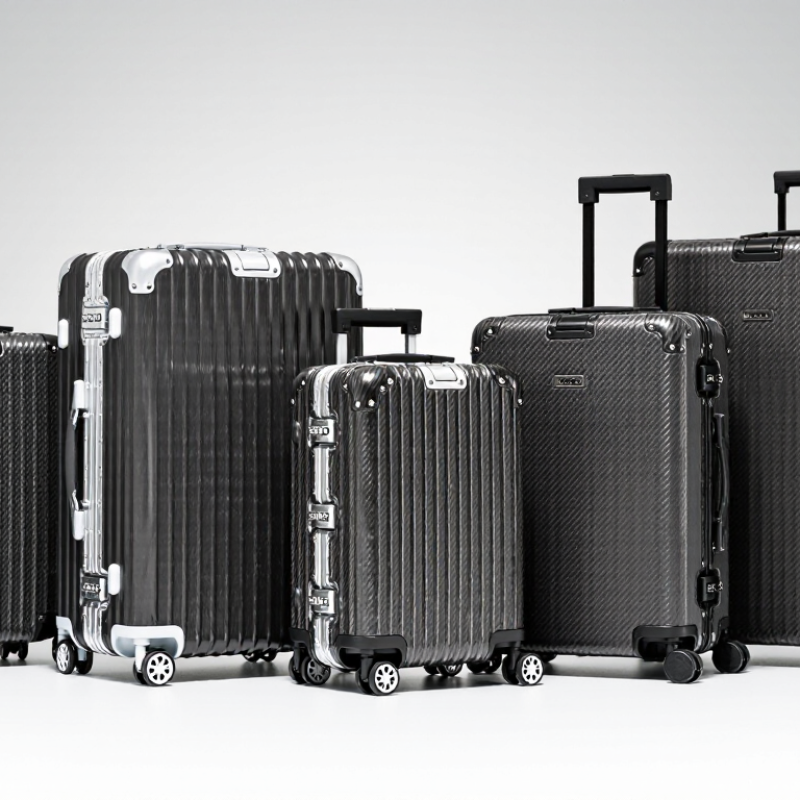
Major carbon fiber luggage types for global buyers in 2026 are compact carry-ons, medium checked cases, trunk cases, and specialty garment luggage. Carry-ons usually suit short business trips, with four-wheel spinners, reinforced corners, and laptop compartments. Medium checked cases offer more space for international travel, but their weight needs careful testing. Carbon fiber reduces shell flex and improves impact resistance, yet it does not make luggage indestructible.
SITA’s 2024 Baggage IT Insights reported 6.9 mishandled bags per 1,000 passengers in 2023. This figure makes wheel quality, handles, and tracking features practical buying concerns. A strong carbon fiber case should combine sealed zippers, replaceable wheels, and a stable telescopic handle. Lightweight construction matters. However, some “carbon fiber” products use only a carbon-pattern surface over plastic. Buyers should request material specifications, shell thickness, testing methods, and warranty terms.
Trunk-style cases target longer journeys and equipment-heavy travelers. Their deeper bodies can improve packing efficiency, but oversized dimensions may create airline restrictions. Garment cases support suits and formal clothing, while compact under-seat models suit frequent regional travel. IATA guidance confirms that cabin baggage rules vary by airline and route. That detail is easy to overlook. In my experience, a slightly smaller case often performs better globally than a larger one with uncertain acceptance. Carbon fiber also costs more, and the premium is not always justified for occasional travel.
How to Compare Size, Capacity, Security, and Mobility
2026 carbon fiber luggage should be compared by use, not appearance. Start with size and capacity. A compact cabin case usually fits short business trips, while a 26–30-inch case suits longer travel. Check internal volume, not only external dimensions. Wheels and handles consume useful space. IATA notes that checked-baggage limits commonly use a 158-centimeter total dimension, but airline rules still vary. Always verify the carrier’s current policy.
Security needs practical testing. A strong shell can resist impact, yet poor zippers may weaken the case. Look for lockable pulls, reinforced corners, and protected wheel housings. SITA’s 2024 Baggage IT Insights reported 6.9 mishandled bags per 1,000 passengers in 2023, representing about 36.1 million bags. That figure makes identification and tracking features worth considering. Still, tracking is not protection. I sometimes overvalue shell strength and overlook repair access. That is a real buying mistake.
Tips: Lift the empty case. Test the handle at full height. Roll it over rough pavement. Measure the packed case with wheels included. Compare usable liters, warranty terms, and replacement-part access. Four quiet wheels improve mobility, but they can suffer on stairs and uneven surfaces. Two larger wheels may be less elegant, yet often handle cracked sidewalks better. Check twice.
Key Buying Factors: Durability, Weight, Price, and Warranty
In 2026, carbon fiber luggage comes in several useful types: compact carry-ons, medium checked cases, expandable trunks, and hybrid bags with fabric panels. Each suits a different travel pattern. Carry-ons reduce handling risks and fit short business trips. Larger trunks offer space but face more impacts during airport transfers. In product evaluations, I check shell thickness, corner protection, handle movement, and wheel alignment. Carbon fiber looks strong, but appearance alone proves little. Some cases use carbon fiber only as a decorative layer.
Durability should come before weight savings. A reliable case should resist repeated drops, twisting, and rough wheel contact. Check the zippers, frame joints, and telescopic handle carefully. Small defects often appear there first. Weight still matters when airline limits are strict. A lighter case can protect more of your packing allowance. However, ultra-light construction may reduce padding or structural support. I have seen attractive cases flex more than expected. That experience makes published weight claims worth questioning.
Price should reflect materials, assembly quality, repair access, and testing evidence. Ask whether replacement wheels, handles, and locks are available in your region. A low purchase price can become expensive after one damaged component. Warranty terms need equal attention. Check coverage length, transport damage exclusions, proof-of-purchase rules, and international service procedures. A clear warranty builds trust; vague wording does not. Buyers should request written details before ordering, especially for long-distance travel.
Global Standards, Market Trends, and Suitable Buyer Profiles
2026 Top Carbon Fiber Luggage Types for Global Buyers
Carbon fiber luggage is moving beyond a luxury image. Buyers now compare shell strength, weight, repairability, and airline compatibility. Full-shell cases suit frequent international travelers needing rigid protection. Hybrid cases combine carbon composite panels with flexible materials. They often handle overhead-bin pressure better. Framed models fit business users carrying laptops and documents. However, carbon fiber can crack after concentrated impact. Replacement parts may also be harder to source than standard shells.
Global standards remain uneven. IATA does not impose one universal cabin-bag size; airlines publish their own limits. SITA’s 2024 Baggage IT Insights reported 6.9 mishandled bags per 1,000 passengers in 2023. That figure was 63% lower than in 2007, but handling damage still matters. Buyers should request impact testing, wheel-cycle results, and material specifications. ASTM D3039 can help verify composite tensile properties, although it is not a complete luggage standard. Ask for test conditions, not just certificates.
Tips: Measure your airline’s current cabin limit. Check wheel clearance and handle stability. Choose reinforced corners for checked travel. Inspect the zipper, frame joints, and repair policy. A lighter case is not always better. That trade-off deserves more attention. Frequent flyers may value service access over a lower empty weight. Retailers should also explain whether the shell is pure carbon fiber, a carbon composite, or decorative laminate.
Buyer-fit interpretation: Underseat and cabin cases suit frequent business travelers and short-haul passengers. Medium and large checked cases are appropriate for international leisure travelers and families. Carbon-fiber trunks are better suited to premium travel, equipment transport, and buyers prioritizing impact resistance over compact storage.
The dimensions are representative global luggage-format benchmarks, not company or brand data. A widely referenced international cabin benchmark is approximately 55 × 40 × 20 cm; airline limits vary by route and carrier. Many checked-baggage policies use a total linear dimension near 158 cm, subject to carrier-specific rules.

 Skip to content