...

How to Choose Prison LED Downlights for Buyers

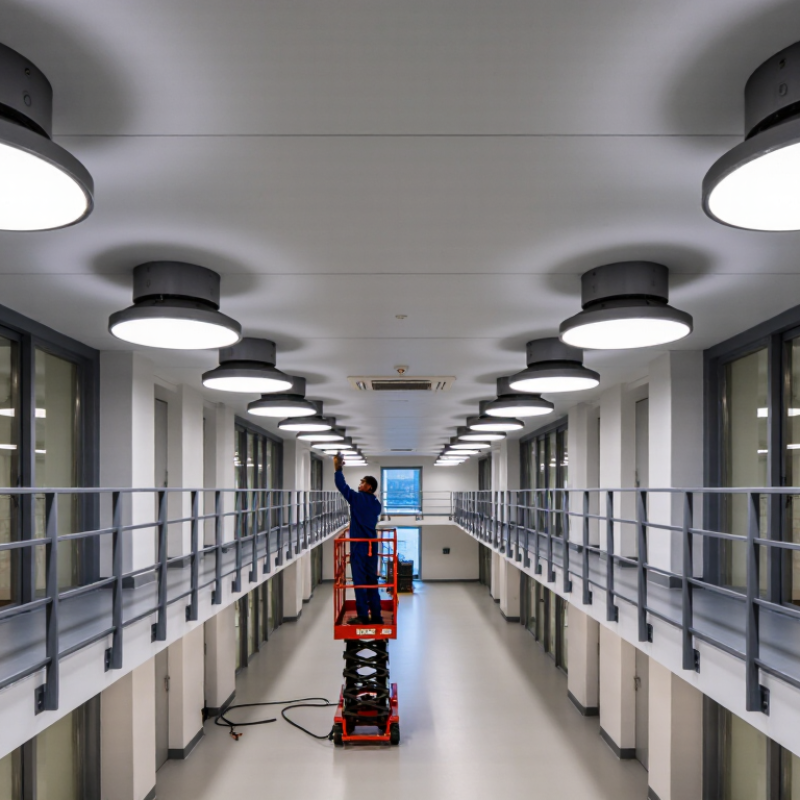
Choosing a Prison LED Downlight is not simply a matter of selecting a wattage. Buyers must consider impact resistance, glare control, maintenance access, and consistent illumination across cells and shared spaces. A fixture may look suitable on a product sheet yet perform poorly in a small room with pale walls and a low ceiling. Details matter.

The International Energy Agency has reported that lighting represents about 15% of global electricity use and 5% of greenhouse gas emissions. Those figures describe lighting broadly, not correctional facilities specifically. Still, they show why efficient lighting deserves careful attention. The U.S. Department of Energy says LEDs use at least 75% less energy than incandescent lighting and can last up to 25 times longer. These are broad comparisons, not guaranteed savings for a prison project. Actual results depend on operating hours, controls, fixture design, and maintenance.

This guide explains how buyers can compare optical performance, durability, color quality, and energy use before specifying a Prison LED Downlight. It also considers installation details, such as ceiling depth and access for routine cleaning. Ask suppliers for verified photometric data, product test documentation, and clear warranty terms. A low purchase price can be tempting. But replacing a poorly chosen fixture repeatedly may cost more over time. One point is easy to overlook: no specification can replace a site assessment by qualified lighting professionals.
How to Choose Prison LED Downlights for Buyers

Specify Security Ratings: IK10 = 20 J; IP65 = Dust-Tight, Water-Jet Protected

How to Choose Prison LED Downlights for Buyers

When comparing prison LED downlights, check the impact and ingress ratings on the complete fitting. IK10 means protection against an impact of 20 joules, such as a 5-kilogram test mass dropped from 400 millimetres under the applicable test method. It does not mean the fixture will withstand every attack or installation condition. IP65 means dust-tight construction and protection from water jets. It does not certify submersion. Check that the rating applies to the assembled luminaire, including its lens, seals, and cable entry.

Tips: Ask for test documentation and confirm the stated standards. Inspect how the fitting mounts, and whether exposed edges or fixings could loosen. Match the beam angle and light output to the ceiling height and room layout. Check the details. Ratings matter, but they are only part of the specification.

Also review temperature limits, cleaning requirements, driver access, and expected maintenance intervals. A sealed fixture may need more careful servicing, and replacement parts should remain available. Confirm compatibility with the site’s electrical system and approved installation details. Don’t assume an IP65 rating makes every cleaning method suitable; follow the manufacturer’s instructions. The label can look reassuring, but I’d still verify the evidence and installation conditions before approving a product.
Confirm Luminaire Safety: IEC 60598 Compliance and Anti-Ligature Design

Safety & compliance Prison LED downlights need more than a robust-looking trim. Check the exact model’s IEC 60598-1 test documentation for electrical, thermal, and mechanical safety, then confirm IEC 60598-2-2 requirements where the luminaire is recessed. Ask for the certificate and test report, not just a supplier’s statement of compliance. That matters. A product’s safety depends on its installed configuration, including the driver, fasteners, ceiling opening, and wiring.

Anti-ligature assessment Anti-ligature design should be assessed as a complete, installed assembly. Look for a smooth, flush face with no accessible gaps, protruding screws, or removable edges. Ask how the fitting resists impact and whether maintenance can be done from the secure side. “Anti-ligature” is not, by itself, a universal performance rating; require the test method and results behind the claim. A high ingress-protection rating does not prove ligature resistance.

Efficiency & installation Efficiency still matters, but it cannot replace safety evidence. The U.S. Department of Energy’s 2022 Solid-State Lighting R&D Opportunities report discusses LED-package efficacy targets of up to 250 lumens per watt by 2035. Higher efficacy is useful; it says little about a downlight’s secure construction. Compare thermal test results, surface temperatures, and service access for the specified ceiling. A perfect datasheet is not the whole installation. Walk the room, inspect the edges, and document any mismatch before approval.

Compare Light Output: LM-79-Tested Lumens, lm/W, CRI, and Uniformity

When choosing prison LED downlights, compare measured fixture output, not the LED package’s advertised lumen figure. Request an LM-79 test report showing lumens for the complete luminaire and the conditions used. Then check efficacy in lumens per watt. A high lm/W value can reduce energy use, but it does not prove that a room will be bright or evenly lit. Review the photometric layout against ceiling height, spacing, and the room’s actual surfaces.

Tips: Ask for the test report and an IES file. Compare products at the same wattage and beam angle. Check whether stated values apply to the full fixture, not a bare light source.

CRI describes how accurately colors appear; a higher score can help staff distinguish clothing, surfaces, and details. Still, CRI alone cannot show whether faces or floor areas will look clear. Review a sample installation when possible. Look for harsh glare, dark patches, and sharp brightness changes near walls or doorways. Uniformity matters: a strong center beam with dim corners may look impressive on paper but perform poorly in a real room. I would also question any quote that lists lumens without test conditions. That detail is easy to overlook.

How to Choose Prison LED Downlights for Buyers — Compare Light Output: LM-79-Tested Lumens, lm/W, CRI, and Uniformity
Generic Output Profile Delivered Light Output Input Power Calculated Efficacy CRI Selection Criterion LM-79 Evidence to Request Uniformity Check
Compact / lower-output 1,500 lm 15 W 100 lm/W Ra ≥ 80 as a general specification target; confirm any project-specific requirement. Request an LM-79 report for the exact luminaire configuration. Confirm reported lumens, input watts, efficacy, CCT, and test conditions. Use project photometry to calculate Emin/Eavg on the specified floor or work plane. Set the acceptance target from applicable requirements and the lighting design.
Standard / medium-output 2,200 lm 20 W 110 lm/W Ra ≥ 80 as a general specification target; compare like-for-like CCT and operating conditions. Check that the report identifies the tested model and matches the offered optics, CCT, and drive current. Do not rely on LED-package lumens as luminaire output. Review the calculated illuminance grid, including corners and areas between fittings. Verify the chosen Emin/Eavg criterion for the actual room layout.
High-output 3,300 lm 30 W 110 lm/W Ra ≥ 80 as a general specification target; request the CRI value from the product data or test documentation. Compare LM-79-reported luminaire lumens and efficacy with the procurement schedule. Confirm that the report applies to the supplied configuration. Assess uniformity using the proposed spacing, mounting height, beam distribution, and room reflectances; confirm through calculations and, where required, field measurements.

Buyer’s note: The profiles above are illustrative procurement benchmarks, not measurements or claims for specific products. Efficacy is calculated as delivered lumens divided by input watts. Uniformity is installation-dependent rather than a single luminaire rating; Emin/Eavg means minimum illuminance divided by average illuminance on the defined measurement plane. Specify the required uniformity and illuminance levels for the project and applicable regulations.

Check Service Life: LM-80/TM-21 Data and L70 Rated Hours

LM-80 and TM-21 help buyers assess LED light-source durability, but they describe different things. LM-80 measures lumen maintenance for LED packages, arrays, or modules under controlled temperatures and drive currents. It does not test the complete downlight. TM-21 uses that test data to project future lumen maintenance. Ask for reports matching the exact LED source and operating conditions in the proposed fixture. A familiar-looking table may refer to a different configuration.

L70 rated hours indicate when projected light output reaches 70 percent of its initial level. They do not promise that a downlight will operate for that many hours without failure. That distinction matters. A unit may still produce light after reaching L70, while its driver could fail earlier. Check driver-life information separately, along with warranty terms and the fixture’s operating-temperature limits.

Prison downlights may run for long periods in warm ceiling spaces, so compare test temperatures with the conditions at the installation site. Look for the LM-80 test duration and TM-21 projection method, not just a large L70 number. If the supplier cannot connect the rating to the exact model, treat the figure cautiously. Even good data cannot fully predict every site. That is worth remembering.

Validate Installation Costs: Emergency Backup, Controls, and Warranty

When comparing prison LED downlights, include installation and service costs, not just the fixture price. Ask for a written breakdown covering labor, access equipment, wiring, and testing. A low quote can omit work needed to connect emergency backup units or existing controls. That gap may appear later.

Confirm how emergency backup operates and how long it supports lighting. Ask whether each unit needs a separate battery, test switch, or scheduled inspection. A brief power-loss test can reveal wiring or commissioning issues before handover. Small details matter. Dimming and occupancy controls can reduce energy use, but only when they suit the facility’s operating routines. Check compatibility with the proposed drivers and emergency circuits. Complicated settings may create extra training and troubleshooting.

Review the warranty in writing. Check its term, covered components, labor provisions, and exclusions for drivers, batteries, or harsh cleaning conditions. Ask how claims are handled and what documentation is required. Compare expected maintenance visits and replacement access, not just warranty length. One estimate may still miss a practical detail, such as the time needed to reach a recessed fitting safely. Verify assumptions with the installer, and keep drawings, test records, and product specifications together for future maintenance.

ICB_lOGO_2023