How to Choose the Right Cabinet Hinge in 2026?
Choosing the right Cabinet Hinge in 2026 requires more than matching a finish to a door. The hinge controls movement, alignment, closing force, and long-term comfort. A beautiful cabinet can still feel cheap when its doors scrape, sag, or slam.
Gary Striegler, a respected cabinetmaking expert, offers a practical rule: “Measure twice, cut once.” That advice matters here. Measure the door thickness, overlay, cup position, and cabinet opening before selecting hardware. A small error can create uneven gaps across an entire kitchen. I have seen a two-millimeter mistake become a visible row of crooked doors.
Details matter.
Modern buyers must also compare soft-close performance, opening angles, load capacity, corrosion resistance, and adjustment range. Stainless steel may suit humid kitchens, while nickel-plated steel can provide a balanced option for ordinary interiors. Frameless and face-frame cabinets need different mounting solutions. Full overlay, half overlay, and inset doors also require specific hinge geometries.
Do not trust appearance alone. Some hinges feel smooth during installation but weaken under daily use. Others offer impressive specifications but adjust poorly on site. This is where product testing, manufacturer documentation, and installer experience become essential. The “best” Cabinet Hinge is not universal. It depends on the door, cabinet construction, environment, budget, and expected use.
There is room for doubt. Catalog measurements can be confusing, and real installations rarely remain perfect. A careful choice leaves adjustment space, checks alignment after installation, and accepts that attractive hardware is only part of reliable cabinet performance.
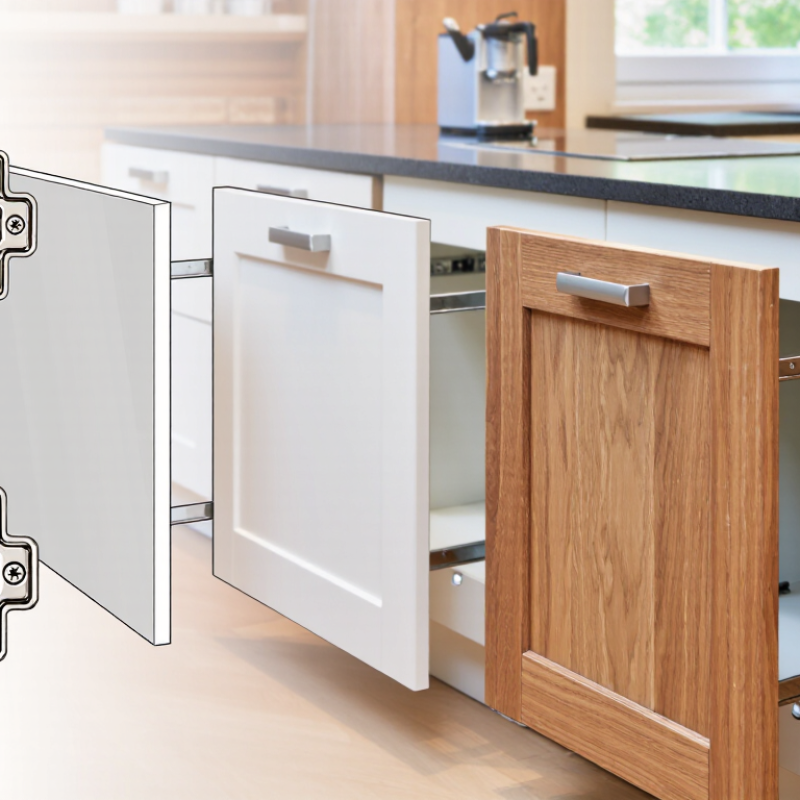
Identify Door Construction: Frameless, Face-Frame, and 35 mm Cup Compatibility
How to Choose the Right Cabinet Hinge in 2026?
Identify Door Construction: Frameless, Face-Frame, and 35 mm Cup Compatibility
Choosing a cabinet hinge starts with the cabinet box, not the hinge package. Check whether the cabinet is frameless or face-frame construction. A frameless cabinet has a clean, exposed side panel around the opening. Its hinge usually mounts directly to the cabinet wall. A face-frame cabinet has a wooden frame surrounding the opening. Its hinge must attach to that frame or use a compatible adapter.
Measure the door overlay carefully. Overlay describes how far the door covers the cabinet opening. Full-overlay, half-overlay, and inset doors require different hinge geometry. Hold a ruler against the closed door and record the coverage on the hinge side. Small errors can cause rubbing, uneven gaps, or a door that will not close smoothly.
Many modern hinges use a 35 mm cup bored into the back of the door. The diameter alone is not enough. Confirm the cup depth, screw-hole spacing, distance from the cup edge, and door thickness. Also check the mounting plate height and adjustment range. I have seen a correct-looking 35 mm hinge fail because the bore sat too close to the door edge. That measurement is easy to overlook.
Test one hinge before ordering a full set. Open and close the door slowly. Watch the gap near the top corner. It should remain even. My own measurements are not always perfect, especially on older cabinets, so a physical test can reveal assumptions that a specification sheet cannot.
Compare Opening Angles: 95°, 110°, 120°, and 165° Hinge Models
How to Choose the Right Cabinet Hinge in 2026?
Opening angle determines how comfortably a cabinet door moves, not just how far it swings. A 95° hinge suits compact cabinets, narrow aisles, and doors beside walls. It reduces collision risk, but access inside can feel limited. I have found this angle practical for small bathroom units and tight utility rooms.
A 110° hinge remains a dependable general-purpose choice. It gives better shelf visibility without demanding excessive side clearance. For wide doors, a 120° model can make drawers and stored cookware easier to reach. However, the extra movement may expose nearby handles, walls, or appliances to impact. Measure the full swing path, not only the cabinet opening. Small details matter.
A 165° hinge creates a near-flat opening, which helps when two adjacent doors must stay clear. It can benefit corner cabinets and wide storage units. Yet it needs suitable mounting space and strong door support. Door weight, overlay, cup drilling, frame thickness, and soft-close hardware still affect the result. Opening angle alone is never enough.
My first instinct was to choose the widest angle for maximum access. That was not always wise. A door may open farther but work poorly beside a wall. Check the hinge specification, install one sample, and test it with shelves loaded. Real furniture often differs from drawings. Recheck the measurements before ordering.
Evaluate Load Capacity: Door Weight, Material Thickness, and 3-Way Adjustment
How to Choose the Right Cabinet Hinge in 2026?
Evaluate Load Capacity: Door Weight, Material Thickness, and 3-Way Adjustment
A suitable hinge begins with the complete door, not the hinge alone. Measure the door’s weight, height, width, and material thickness before choosing hardware. Solid wood and thick glass doors create different stresses than lightweight composite panels. Check the hinge’s rated capacity per hinge, then allow a practical safety margin. Never treat the advertised maximum as a daily target.
A common working guide is two hinges for smaller doors and three or more for taller, heavier doors. However, door height can matter as much as weight. A narrow, heavy door may pull differently from a wide, lightweight one. The mounting screws also need enough material to grip. Thin panels may require suitable reinforcement or shorter screws. Too much screw length can damage the door.
Three-way adjustment usually covers height, side-to-side alignment, and depth. These settings help correct uneven gaps after installation. They do not increase the hinge’s load capacity. Small adjustments can prevent rubbing, but excessive adjustment may weaken stability. Check the door after several openings. It should close smoothly, without dropping or twisting. One honest limitation remains: load charts cannot predict every installation. Moisture, poor drilling, and loose screws can change the result. Recheck them.
Verify Durability Features: Soft-Close Systems and 80,000-Cycle Testing
How to Choose the Right Cabinet Hinge in 2026?
Verify Durability Features: Soft-Close Systems and 80,000-Cycle Testing
Choosing a cabinet hinge in 2026 requires more than matching cup diameter or finish. Soft-close performance deserves equal attention. During inspection, the damper should engage smoothly near the final closing inches. The door should settle quietly, without rebound or a visible gap. Industry testing references, including EN 15570:2008 and ANSI/BHMA A156.9, frame durability around repeatable hardware performance. An 80,000-cycle test is a useful benchmark, not decoration. At ten openings daily, that figure represents almost 22 years. Real kitchens are less predictable.
Ask for the laboratory report, test load, door mass, opening angle, mounting method, and failure criteria. A credible report identifies the hinge model and records adjustment after cycling. It should also state whether the soft-close damper survived separately from the hinge body. A cabinet door may pass a cycle count yet slam after installation. Numbers can mislead. Misalignment, loose screws, and uneven cabinet boxes create stresses that laboratory fixtures may not reproduce. This is where installer judgment matters.
Choose hinges with accessible three-way adjustment and replaceable mounting hardware. Check the damper with both a light empty door and a heavier loaded door. The closing speed should remain controlled, not painfully slow. In practice, 80,000 cycles is strongest when paired with corrosion checks, load verification, and installation instructions. I would record the test date and conditions before comparing quotes. The weakest detail is often overlooked.
How to Choose the Right Cabinet Hinge in 2026?
Verify durability features: soft-close systems and 80,000-cycle testing
Use cycle-count checkpoints to compare hinge durability claims. An 80,000-cycle test represents a demanding durability target; when evaluating a soft-close hinge, also confirm the test method, load, door weight, adjustment conditions, and whether the soft-close mechanism remained functional throughout testing.

 Skip to content