
 Skip to content
How to Source Colorful Eyeshadow in 2026? The question reflects a wider shift in beauty buying. McKinsey & Company and The Business of Fashion’s State of Fashion: Beauty 2025 report projects the global beauty market could approach $590 billion by 2030. Makeup remains a visible part of that expansion. Circana also reported continued growth in U.S. prestige makeup sales during 2024, supported by premium launches and expressive color choices. These figures suggest opportunity, but they do not guarantee demand for every neon palette.
Reliable sourcing starts with evidence, not attractive swatches. A supplier should provide complete INCI ingredient lists, batch traceability, microbial testing, stability results, and clear manufacturing records. Ask for pressed samples in cobalt blue, lime green, and metallic violet. Check fallout, blendability, color payoff, staining, and performance under different lighting. A shade that looks vivid in a factory photograph may appear dull on skin. That mistake can become expensive.
International requirements also deserve careful review. Depending on the destination market, brands may need documentation aligned with frameworks such as the EU Cosmetics Regulation, U.S. MoCRA obligations, or relevant quality systems such as ISO 22716. Requirements can change by formula, claim, packaging, and market. Sustainability claims need proof, too. The 2024 Vogue Business Beauty Index highlighted growing consumer attention to transparency and responsible practices. Still, trend reports are imperfect. They can point toward demand, but real customer testing must decide. A disciplined sourcing process combines trend intelligence, laboratory verification, supplier audits, and honest cost analysis before placing a large order.
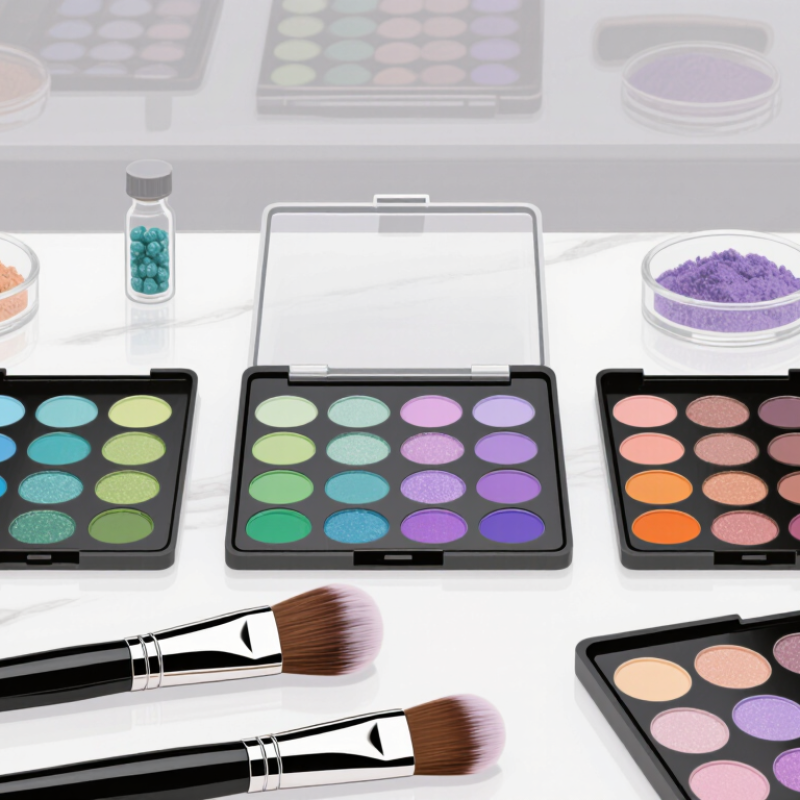
Colorful eyeshadow is more than pressed powder with vivid pigment. It usually includes colorants, binders, emollients, fillers, preservatives, and packaging components. Each part affects payoff, comfort, shelf life, and safety. A practical sourcing decision must examine the whole formula.
Grand View Research estimated the global color cosmetics market at about USD 77.7 billion in 2023. Its 2024 report also projects continued growth through 2030. This expansion makes colorful products attractive, but it increases supplier competition. Buyers should request ingredient lists, certificates of analysis, microbial tests, stability results, and batch records. Bright color alone proves little. I still treat dramatic swatch videos cautiously.
Colorful eyeshadow can contain mineral or synthetic pigments, depending on the target market and formula design. Some pigments perform well on dry skin but crease on oily eyelids. Others look strong in a pan yet fade under warm lighting. Sample testing should include blending, fallout, removal, wear time, and color consistency across batches. The 2024 Circana U.S. beauty report showed continued momentum in prestige makeup, reinforcing demand for expressive color and higher performance. However, market reports measure sales, not user comfort. That gap matters. A responsible supplier should verify regional cosmetic requirements, restricted substances, labeling accuracy, and packaging compatibility before production. Small details, such as a loose sifter or cracked pan, can damage the customer experience. Perfect sourcing is unrealistic. Careful documentation is not.
| sourcing dimension | What Colorful Eyeshadow Includes | Typical Options or Color Families | Why It Matters in 2026 | Supplier Verification Checklist |
|---|---|---|---|---|
| Color System | Pressed powder, loose powder, cream, liquid, stick, or hybrid eyeshadow formats. | Pressed powder Cream Liquid Stick | The format affects application, packaging compatibility, preservative needs, fallout, portability, and expected consumer use. | Request the full formula type, intended use, fill weight, stability data, and compatibility results with the proposed packaging. |
| Colorants | Color additives or cosmetic pigments used to create hue, opacity, brightness, and undertone. | Yellow Orange Pink Red Blue Green Violet White Black | Colorants must be permitted for the intended cosmetic use and market. The same pigment may have different regulatory requirements in different jurisdictions. | Obtain the colorant INCI names, CI numbers where applicable, regulatory status by market, specifications, certificates of analysis, and heavy-metal test results. |
| Finish | Surface appearance and light-reflecting behavior of the finished shade. | Matte Satin Shimmer Metallic Duo-chrome Glitter | Finish influences shade differentiation, particle selection, eye-area suitability, fallout, and the visual result under different lighting. | Request standardized swatches, ingredient-level finish descriptions, particle-size information when relevant, fallout observations, and eye-area safety documentation. |
| Base Ingredients | Powders, binders, emollients, oils, waxes, film formers, texture modifiers, and other formulation components. | Mica-based powders Silicone-treated powders Oils Waxes Film formers | Base ingredients determine blendability, adhesion, payoff, crease resistance, sensory feel, and compatibility with sensitive skin. | Review the complete INCI list, allergen information, restricted-substance screening, raw-material specifications, and formula change-control procedure. |
| Pigment Performance | Color payoff, coverage, buildability, blendability, adhesion, and consistency across batches. | Sheer Buildable High-impact Blendable | Performance claims should be supported by repeatable testing rather than visual samples from only one production batch. | Compare laboratory samples and production samples for color difference, payoff, blendability, adhesion, fallout, and batch-to-batch consistency. |
| Eye-Area Safety | Formula suitability for use around the eyes, including irritation, sensitization, contamination, and particle-related risks. | Eye-area tested Ophthalmologist reviewed Fragrance-free option | The eye area is sensitive, and glitter or poorly controlled particles may create additional user-safety concerns. “Non-irritating” should not be assumed without evidence. | Request safety assessment documentation, preservative or microbiological testing where applicable, irritation or sensitization evidence, and clear use warnings. |
| Regulatory Documentation | Product information file or equivalent technical records, safety substantiation, ingredient documentation, manufacturing records, and market-specific compliance files. | United States European Union United Kingdom Other target markets | Cosmetic requirements differ by market. In the European Union, a cosmetic product requires a responsible person and a cosmetic product safety report. In the United States, companies must meet applicable requirements under the Modernization of Cosmetics Regulation Act, including facility and product obligations where applicable. | Define target markets before ordering samples and confirm responsibility for safety substantiation, product notification or listing, labeling, and adverse-event procedures. |
| Microbiological Quality | Microbial limits, preservative strategy where applicable, manufacturing hygiene, and contamination controls. | Low-water powder Cream formula Liquid formula | Water-containing and emulsion formulas generally require closer microbiological control than anhydrous pressed powders, although every product still needs appropriate quality evaluation. | Request microbiological specifications, test methods, batch-release results, preservative efficacy data where applicable, and manufacturing hygiene records. |
| Stability | Resistance to changes in color, odor, texture, viscosity, adhesion, and microbial quality during storage. | Accelerated stability Real-time stability Freeze–thaw evaluation Light exposure | Bright pigments and sensitive finishes may shift under heat, light, humidity, or repeated opening. Stability evidence supports shelf-life and storage decisions. | Ask for current stability protocols, test conditions, observed changes, proposed shelf life, storage instructions, and packaging interaction results. |
| Packaging Compatibility | Pan, compact, palette, jar, tube, wand, closure, mirror, applicator, and protective components. | Single pan Multi-pan palette Sifter jar Tube | Packaging influences breakage, contamination risk, product preservation, transport performance, user experience, and material compliance. | Perform drop, vibration, leakage, closure, compatibility, rub-off, and transport testing using the final formula and final packaging. |
| Labeling | Product name, net quantity, ingredient list, responsible-party details, batch or lot identification, warnings, and market-required information. | Shade name Net weight INCI list Usage warning | Accurate labeling supports consumer safety, traceability, customs review, and legal market access. | Check ingredient order, color-additive naming, net quantity units, lot coding, required warnings, language rules, and label approval before mass production. |
| Ethical and Environmental Claims | Claims related to vegan formulation, animal testing, recycled content, recyclable packaging, responsibly sourced materials, or reduced waste. | Vegan claim Recycled content Refillable design Reduced packaging | Environmental and ethical claims require clear definitions and substantiation. A claim should describe the actual product, packaging, supply chain, or manufacturing practice. | Request written claim substantiation, material declarations, recycled-content evidence, supply-chain records, and confirmation that wording is acceptable in each target market. |
| Quality Control | Raw-material inspection, in-process controls, finished-product testing, retained samples, batch records, and deviation management. | Color match Texture Fill weight Microbiology Packaging | Colorful products are visually sensitive; small variations in pigment concentration or processing can create noticeable shade differences. | Agree on approved reference samples, acceptance criteria, testing frequency, retained-sample periods, complaint handling, and corrective-action procedures. |
| Supply Planning | Sample development, formula approval, color approval, production lead time, minimum order quantity, capacity, and replenishment planning. | Custom shades Existing shades Small launch Scale-up | Color launches often require multiple rounds of shade approval. Early planning reduces delays caused by pigment availability, testing, packaging, or regulatory review. | Confirm sample lead time, minimum order quantity, production capacity, pigment availability, approval stages, payment milestones, and contingency plans for shortages. |
| Sourcing Decision | A documented comparison of formula, color performance, safety, compliance, quality, packaging, cost, and supply reliability. | Technical fit Regulatory fit Commercial fit | The lowest unit cost does not necessarily provide the best total value if it creates higher testing, compliance, breakage, rejection, or replenishment costs. | Use a weighted scorecard and approve a supplier only after reviewing samples, documentation, test results, commercial terms, and production controls. |