
China has become a major sourcing base for pizza boxes, supported by large paper mills, automated converting lines, and export-focused manufacturers. Global buyers, however, should assess more than unit price. A box must protect a hot pizza, control grease, resist crushing, and support safe food contact. Small details matter, including flute direction, vent placement, lid fit, and print accuracy.
Industry reports provide useful context. Smithers’ The Future of Corrugated Packaging to 2029 identifies continued demand for recyclable corrugated formats across food delivery and takeaway sectors. Grand View Research also reports steady growth in the global food packaging market, driven by convenience consumption and delivery services. These reports do not always separate pizza boxes from wider packaging categories. That limitation deserves attention.
David Luttenberger, Global Packaging Director at Mintel, has said that packaging is often a brand’s first physical experience with a consumer. His point fits pizza boxes closely. A stained lid can weaken customer trust before the first slice is tasted. A clean, rigid box can communicate consistency.
Reliable Chinese suppliers should provide food-contact documentation, recycled-fiber details, ECT or BCT testing, grease-resistant options, and clear production timelines. Buyers should also verify factory capacity, minimum order quantities, color tolerances, and export packaging. Certifications alone are not enough. An audit, sample test, and trial shipment may reveal problems early.
The best supplier is not always the cheapest. Sometimes, the cheaper box costs more through crushed corners, delayed shipments, or poor printing. This guide examines leading China pizza box suppliers for global buyers, while recognizing that supplier performance can vary by order size, material choice, and destination.
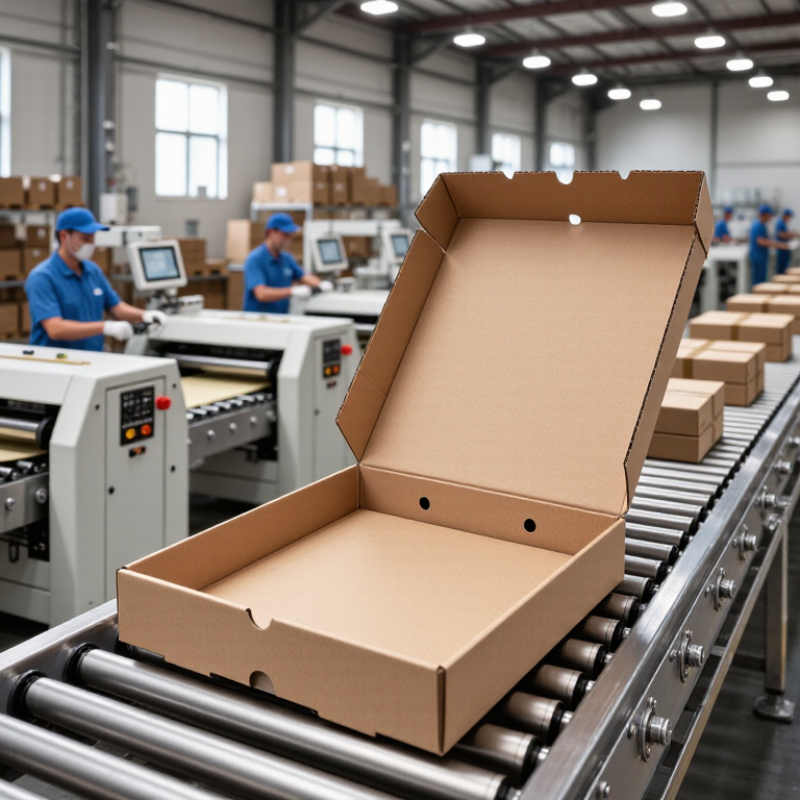
China remains a major production base for pizza boxes, supported by extensive paper mills, corrugated plants, and export logistics. Suppliers serve restaurants, distributors, catering groups, and private-label importers across many markets.
The market is large, but pizza-box figures are difficult to isolate. In 2024, customs records commonly grouped these products under broader paper and paperboard packaging categories, including cartons and containers. This limits the accuracy of standalone trade estimates. Export activity was visible across Asia, Europe, North America, the Middle East, Africa, and Latin America. Shenzhen, Ningbo, Qingdao, and other coastal shipping centers supported regular container movement.
Product details matter more than catalog claims. Typical options include food-grade kraft board, white-lined corrugated board, one-color printing, full-color flexographic printing, and flat-packed delivery. A practical buyer should check board thickness, grease resistance, stacking strength, ink suitability, and moisture protection. Samples should survive compression and short-distance handling before bulk approval.
Prices can look attractive. Quality may vary between batches. Some suppliers also quote quickly but explain export documentation poorly. That is a warning sign. Buyers should request recent production photos, test reports, carton dimensions, packing quantities, and clear 2024 shipment terms. The data is useful, but not perfect. Supplier verification still requires direct testing and careful comparison.
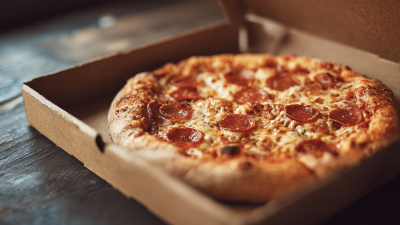
For pizza boxes, 3-ply board usually means two liners and one fluted medium. A 275–350 GSM range offers a practical balance between stiffness, weight, and shipping cost. GSM measures paper mass, not strength. That distinction matters. The Fibre Box Association identifies edge crush test, or ECT, as a key indicator of stacking performance. Common 32 ECT board delivers about 5.6 kN/m, while 44 ECT reaches roughly 7.7 kN/m. Higher numbers can protect stacked cartons, but they may increase material use.
Grease resistance needs separate verification. TAPPI T559 reports resistance through a kit-number method, while Cobb testing measures water absorption rather than oil protection. They are not interchangeable. A food-contact paperboard report by Smithers also highlights moisture and barrier performance as important factors in fiber-based packaging development. In practice, hot cheese, oily toppings, and steam attack the box together. A dry test can look excellent, then fail beside a 90°C pizza. This is where specifications become less certain.
For global buyers comparing China’s top pizza box suppliers, screening should begin with production evidence, not polished catalogs. Ask for the minimum order quantity (MOQ) by size, print method, and board grade. A supplier may quote 10,000 boxes, but charge separately for plates, sampling, or small-run setup. Request a written quotation with unit price, tooling, packing, and delivery terms. Keep every item visible.
A realistic 7–15-day lead time depends on approved artwork, material availability, and order quantity. Confirm whether the clock starts after payment or sample approval. During a factory call, inspect sheet storage, die-cutting lines, folding-gluing equipment, and finished-box pallets. Ask for daily output, shift patterns, and recent production records. Capacity claims need evidence. A photo alone is weak.
Customization should cover dimensions, ventilation holes, locking style, ink coverage, grease resistance, and stacking strength. Request a physical sample made with the intended board, not a substitute. Check odor, print registration, corner alignment, food-contact documents, and compression after simulated delivery. I have seen attractive samples fail when humid cartons softened overnight. That risk deserves a test. Suppliers should provide material specifications, quality checkpoints, and corrective-action records. Some buyers skip these details under deadline pressure, then discover that fast production created inconsistent box sizes. Leave room for inspection and revision.
These procurement reference benchmarks help global buyers compare minimum order quantity, production lead time, daily capacity, and the main customization dimensions available for pizza box projects. The figures are screening benchmarks rather than company-specific claims.
For global pizza box buyers, food-contact compliance begins with the paper, ink, coating, and adhesive. China’s GB 4806.8 standard covers paper, paperboard, and paper products contacting food. Suppliers should also evaluate GB 4806.1 requirements for overall safety. For the United States, 21 CFR 176.170 and 176.180 may apply to paper components contacting fatty or aqueous foods. In Europe, Regulation (EC) No 1935/2004 requires materials to remain safe and non-transferable under intended use. Regulation (EC) No 2023/2006 also supports good manufacturing practice.
Documentation matters. A professional supplier should provide migration test reports, raw-material declarations, ink and adhesive specifications, and batch traceability. Testing should reflect hot pizza, grease, moisture, and direct contact. Laboratory conditions can be too gentle. That is an easy weakness to overlook. The supplier’s declared use must match the actual box design.
Tips: Ask for current reports from an accredited laboratory, not only a factory statement. Confirm whether recycled fiber is used and whether its source is controlled. FSC certification supports responsible forest sourcing, but it does not prove food-contact safety. FSC’s Facts & Figures reporting shows more than 160 million hectares of certified forests and over 50,000 chain-of-custody certificates worldwide. Those figures indicate strong market adoption, but certificates still require verification. Review the certificate scope, invoice details, and packaging claim before printing any FSC label. A small document mismatch can delay customs clearance or retail approval.
| Compliance Dimension | Applicable Reference | What It Covers for Pizza Boxes | Documents or Evidence to Request | Buyer Verification Point |
|---|---|---|---|---|
| China food-contact safety framework | GB 4806.1-2016 | General safety requirements for food-contact materials and articles, including safety, labeling, migration, and conformity principles. | Supplier declaration of compliance, material composition information, migration test reports, and production-control records. | Confirm that the declaration covers the finished box and its intended food-contact conditions. |
| China paper and paperboard requirements | GB 4806.8-2022 | Safety requirements for paper, paperboard, and paper products intended for food contact, including applicable raw materials, additives, and test items. | Current GB 4806.8 test report, raw-material specification, additive information, and batch traceability records. | Check the report date, sample description, thickness, coating, and whether the tested construction matches the supplied box. |
| China inks, coatings, and adhesives | GB 4806 series and applicable related standards | Materials that may transfer from printing ink, grease-resistant coating, adhesive, or recycled-fiber components into food. | Ink and coating declarations, adhesive specifications, supplier compliance statements, and finished-product migration testing. | Verify whether printing is on the non-food-contact side and whether odor, set-off, and mineral-oil risks were assessed. |
| U.S. indirect food additives | FDA 21 CFR 176.170 | Components of paper and paperboard that contact aqueous or fatty foods, subject to the applicable composition and use limitations. | FDA compliance statement identifying each paper, coating, adhesive, and functional barrier; supporting composition and extraction data. | Match the intended pizza, oil, temperature, and contact duration with the conditions covered by the cited regulation. |
| U.S. dry-food paperboard use | FDA 21 CFR 176.180 | Paper and paperboard used in contact with dry food, where the specified conditions and limitations apply. | Regulatory assessment stating whether the product is intended for dry-food contact only or also for hot, moist, or fatty pizza. | Do not rely on a dry-food provision alone when the box contacts hot cheese, oil, sauce, or steam. |
| U.S. manufacturing substances | FDA 21 CFR 175.105 and other applicable sections | Adhesives and other food-contact components, subject to their specific conditions of use and limitations. | Adhesive technical data sheet, FDA status statement, formulation restrictions, and supplier declaration. | Confirm that the adhesive is used as permitted and does not create an unintended direct-contact layer. |
| EU framework safety requirement | Regulation (EC) No 1935/2004 | Materials must not transfer constituents to food at levels that endanger health, cause unacceptable changes, or deteriorate food characteristics. | EU declaration of compliance where applicable, risk assessment, migration or transfer testing, and traceability procedure. | Check that the assessment covers the complete article, including inks, coatings, adhesives, and recycled fiber. |
| EU good manufacturing practice | Regulation (EC) No 2023/2006 | Quality assurance, quality control, documented procedures, suitable premises, and controlled production for food-contact materials. | GMP manual, quality-control plan, process records, corrective-action records, and change-control procedure. | Review controls for ink set-off, contamination, batch identification, and changes to paper or coating suppliers. |
| EU paper and board risk assessment | National requirements and industry guidance may apply | Paper and board are not covered by one fully harmonized, comprehensive EU-specific measure; member-state rules and guidance can be relevant. | Destination-country legal review, substance screening, migration tests, and written compliance rationale. | Identify the importing EU country and verify any applicable national rules before production approval. |
| FSC responsible sourcing | FSC chain-of-custody requirements | Traceability of certified forest-based material through certified supply chains; this is a sourcing claim, not a food-safety approval. | Valid certificate code, certificate scope, product classification, transaction records, and approved claim wording. | Verify certificate validity and scope independently; do not treat FSC status as proof of food-contact compliance. |
| Migration and sensory testing | Destination-market test methods and conditions | Potential transfer of substances, odor, or taste from the finished box to hot, moist, or fatty pizza during the declared contact period. | Independent laboratory report, test conditions, simulants, contact time, temperature, detection limits, and conclusions. | Ensure the tested finished construction—not only the base paper—matches the production specification. |
| Supplier qualification | Buyer quality system and applicable market rules | Capability to maintain consistent dimensions, ventilation, print quality, material composition, and food-contact performance across batches. | Factory audit, sample approval, inspection plan, certificate list, corrective-action history, and lot-traceability procedure. | Approve a controlled sample and define notification requirements for any material, ink, adhesive, or process change. |
FOB pricing is only the factory-side number. It normally excludes ocean freight, insurance, destination handling, customs clearance, and inland delivery. The World Bank’s 2023 Logistics Performance Index reports that international supply chains can take about 44 days from port to port. That delay ties up cash and may require extra safety stock. A buyer should compare landed cost per usable box, not the quoted FOB carton price.
Use a clear model: FOB unit price plus freight, port fees, duty, inspection, and local transport. Add expected defect cost. For example, a 2% defect rate on 100,000 boxes means 2,000 unusable units. Rework, disposal, and emergency replacement can exceed the original price gap. Packaging specialists often recommend measurable acceptance limits, including print alignment, board thickness, moisture resistance, and food-contact documentation. I would still request production samples. Specifications can look perfect on paper.
Reorder decisions should track four KPIs: landed cost variance, defect rate, on-time shipment rate, and days to replenish. UNCTAD reports that maritime shipping carries over 80% of global merchandise trade, so vessel delays remain a practical risk. A supplier with a slightly higher FOB price may perform better after freight and defects. However, one shipment is weak evidence. Review at least three purchase cycles, and record every shortage, dented corner, odor issue, and late document. My own comparison would include a small buffer, because forecasts are rarely as accurate as buyers expect.